Anna Wickenkamp
In today’s crowded social media feeds, political messages do not succeed solely because they are informative. They succeed (among other factors) because they feel morally urgent, a dynamic that appears to be especially leveraged by populists, who often thrive in social media environments.This is why, in my first year paper, I explored how political parties use moral language on social media, and whether populist parties do so differently from mainstream ones. We analyzed 11,205 posts from political parties and party leaders on X, Facebook and Instagram during the 2023 Dutch election campaign, using Moral Foundations Theory (Graham et al., 2009), which groups moral language into five moral themes: Care/Harm, Fairness/Cheating, Loyalty/Betrayal, Authority/Subversion and Purity/Degradation.
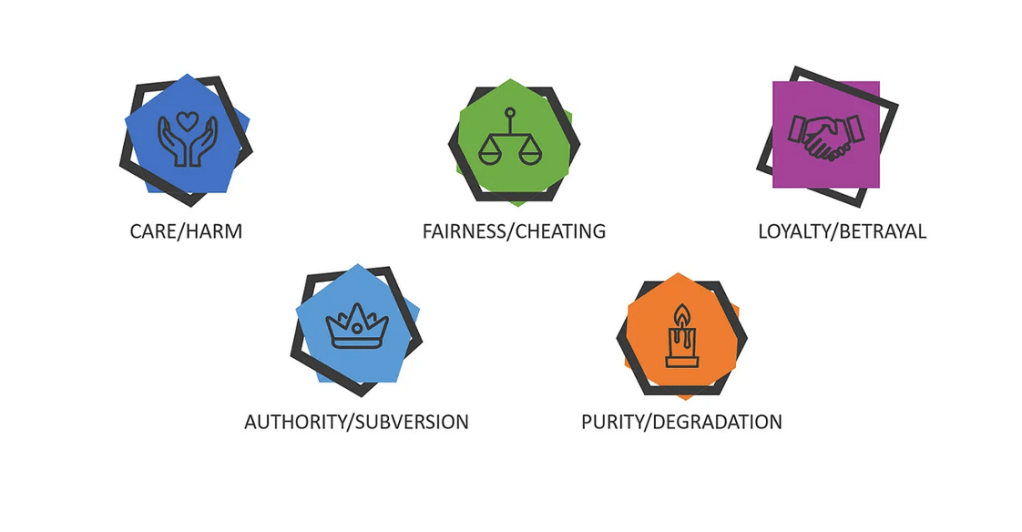
Image taken and adapted from https://www.qrca.org/blogpost/1488356/Qual-Power?tag=corporate+morality
The key finding is subtle but important. Populist parties did not have a completely unique moral vocabulary. They were not using an entirely different set of words from everyone else. What made them distinct was the underlying moral appeals they relied on. Compared with mainstream parties, populists placed relatively greater emphasis on Care/Harm and Authority/Subversion language, reflecting appeals centered on preventing suffering and the structure of social order.
The study also found that, among right-wing populist parties, these emphasized moral themes were often tied to national identity, migration, citizens and perceived external threats. In contrast, mainstream right-wing parties used these moral foundations linked to cooperation, the rule of law, security and social cohesion.
Another interesting result is that populist parties were not simply “more moral” in a broad sense. In fact, mainstream parties used moral language slightly more often overall. But populists used more negative moral language, meaning words associated with harm, corruption, betrayal and threat. They also varied their moral messaging more across social media platforms. Mainstream parties were more consistent across X, Facebook and Instagram, while populists appeared more willing to adapt their tone depending on the platform and audience. Why does this matter? Because moral language is powerful. It grabs attention, triggers emotion and helps people make quick judgments in complex political debates. This study suggests that the success of populist communication online is not just about the simplification of topics into an “us versus them” binary. It is also about turning politics into a moral drama: good people needing protection, bad actors causing harm, and populist leaders promising to restore sovereignty and control of the good people.

Anna Wickenkamp is a PhD candidate at the Amsterdam School of Communication Research (ASCoR). Her doctoral research explores the role of morality in the success of populist parties in multi-party systems. She examines not only how populist parties use moral rhetoric compared with mainstream parties, but also which moral values resonate with voters across different populist and non-populist camps.


Leave a Reply